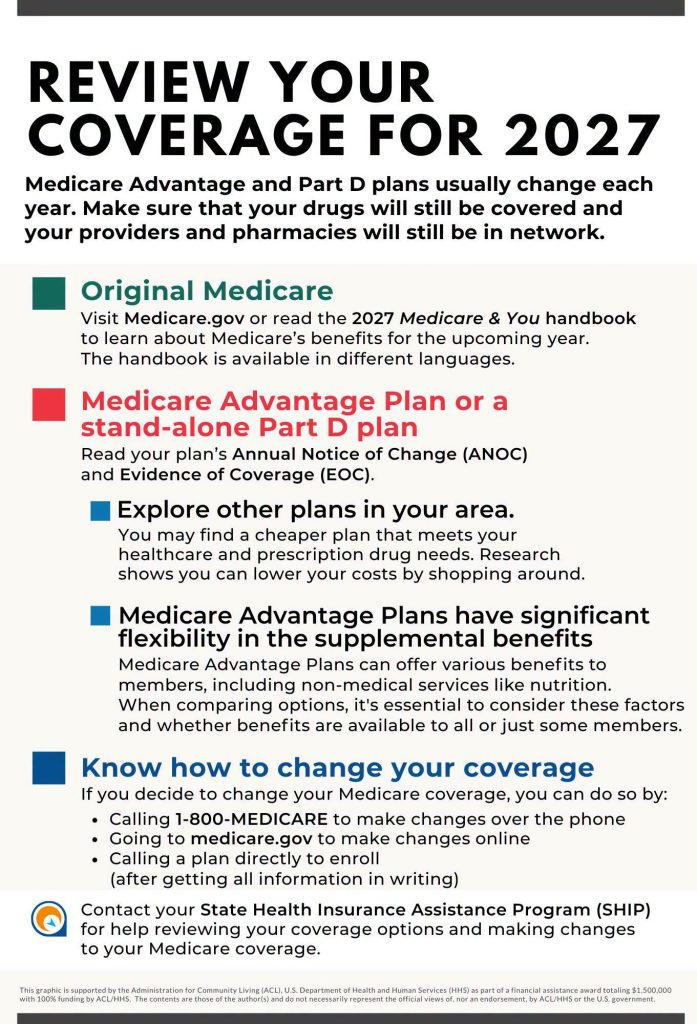
Medicare beneficiaries know the feeling: the mailbox fills up fast, especially as fall approaches. It’s tempting to set aside the stack of envelopes and deal with them “later,” but a few key documents arriving in the coming weeks are essential to understanding your coverage for 2027 — and making confident decisions during Medicare’s Open Enrollment period.
From October 15 through December 7, Medicare Open Enrollment gives you the opportunity to review your current coverage, compare options, and make changes if needed. Even if you’re happy with your plan, it’s important to check for updates. Medicare Advantage and Part D prescription drug plans can change every year, and those changes may affect your costs, your providers, and the medications you rely on.
Here’s what to watch for — and how these documents can help you prepare.
1. Your Medicare & You Handbook (Original Medicare)
If you’re enrolled in Original Medicare, keep an eye out for the Medicare & You handbook, typically mailed in September. This guide outlines benefits, costs, and updates for the upcoming year. It’s also available online at Medicare.gov and in multiple languages.
This handbook is your annual roadmap — a reliable way to understand what’s new, what’s changing, and how those changes may affect your healthcare.
2. Annual Notice of Change (ANOC) & Evidence of Coverage (EOC)
If you have a Medicare Advantage plan or a stand‑alone Part D prescription drug plan, your plan will send two important documents:
- Annual Notice of Change (ANOC) – Summarizes changes to your plan for next year, including premiums, deductibles, copays, covered medications, provider networks, and pharmacy options.
- Evidence of Coverage (EOC) – Provides detailed information about what your plan covers and how it works.
Reviewing these documents now helps you confirm that your doctors, pharmacies, and prescriptions will still be covered in 2027 — and that your plan continues to meet your needs.
3. Explore Other Plans in Your Area
Even if your current plan still fits your needs, it’s smart to compare. Research shows that beneficiaries can often lower their costs by shopping around. Medicare Advantage plans also have flexibility in offering supplemental benefits, including non‑medical services like nutrition support. When comparing plans, pay attention to which benefits are available to all members versus only some.
4. Know How to Make Changes
If you decide to switch plans during Open Enrollment, you have several options:
- Call 1‑800‑MEDICARE to make changes over the phone
- Visit Medicare.gov to compare and enroll online
- Contact a plan directly (after receiving all information in writing)
And remember — you don’t have to navigate this alone.
5. Get Free, Unbiased Help from SHINE
In Florida, you can turn to SHINE — Serving Health Insurance Needs of Elders — our state’s version of the national State Health Insurance Assistance Program (SHIP). SHINE provides free, unbiased, one‑on‑one counseling to help you review your options, understand plan changes, and make confident decisions. In Southwest Florida, you can reach your local SHINE Helpline at 866‑413‑5337 for personalized assistance.
Bottom Line
Medicare mail may feel overwhelming, but reviewing a few key documents now can save you money, protect your access to care, and ensure your coverage truly fits your needs in 2027. As Open Enrollment approaches, take time to read your notices, explore your options, and reach out for help if you need it.


Last Updated: October 14, 2026 by Leave a Comment
How to Report Elder Abuse
Area Agency on Aging for Southwest Florida has joined Secure Seniors Florida’s elder abuse prevention efforts to remind our community how and when to report elder abuse, neglect and exploitation.
Elder abuse means hurting, neglecting or taking advantage of an older person. Chapter 825, Florida Statutes, makes it a crime to abuse, neglect or exploit an elderly person. The law defines an elderly person as someone age 60 or older whose ability to care for or protect themselves is impaired by the infirmities of aging.
Florida’s Adult Protective Services Act, Chapter 415, Florida Statutes, requires any person who knows or has reasonable cause to suspect that a vulnerable adult is being abused, neglected or exploited to report it immediately. A vulnerable adult is anyone 18 or older whose ability to care for or protect themselves is impaired, including by the infirmities of aging.
If you see something or feel something is wrong, say something. Reporting helps keep older adults safe.
When to report
Residents should report right away if:
You do not need proof to make a report.
How to report, 24 hours a day
What happens next
Trained workers check the report, help is sent if needed, and the reporter’s name is kept private.
The “How to Report Elder Abuse” flyer is available for download here and may be shared freely.
Posted: September 30, 2026 by Leave a Comment
Volunteers Needed! Become a Tai Chi for Arthritis Volunteer
The Area Agency on Aging for Southwest Florida (AAASWFL) is looking for enthusiastic volunteers to lead our Tai Chi for Arthritis and Fall Prevention (TCA) classes!
Help older adults improve their balance, build strength, prevent falls, and stay active while making a meaningful difference in your community.
No prior Tai Chi experience is necessary! AAASWFL provides certification training through the Tai Chi for Health Institute, CPR certification, ongoing support, and opportunities to shadow experienced instructors.
Give the gift of better balance, confidence, and independence. Become a volunteer today!
Interested in joining us? Contact the AAASWFL Health & Wellness Department to learn more about becoming a certified Tai Chi volunteer.
Posted: August 31, 2026 by Leave a Comment
Discover Local Support at AAASWFL’s Fourth Annual Community Resource Fair
Finding the right resources for yourself or a loved one can feel overwhelming — especially when navigating questions about Medicare, caregiving, long‑term care, or community services. That’s why the Area Agency on Aging for Southwest Florida (AAASWFL) is proud to host its fourth annual Community Resource Fair on Friday, September 25, from 1:00 to 3:00 p.m. at 2830 Winkler Avenue, Suite 112, Fort Myers, FL 33916.
This free event is designed to bring helpful information, trusted organizations, and knowledgeable experts together in one place, making it easier for older adults, adults with disabilities, caregivers, and families to find the support they need.
A Growing Tradition of Connection and Community
Over the past several years, the Community Resource Fair has grown into a beloved annual tradition. The event has previously been featured by WINK News, giving viewers a look at the many services, resources, and meaningful connections the fair provides.
This year, attendees will once again have the chance to meet face‑to‑face with local organizations, ask questions, and learn about programs available throughout Southwest Florida. SHINE counselors will be on site to help with Medicare questions, and AAASWFL’s Information & Referral team will be available to guide attendees toward local services and supports.
Meet the 2026 Exhibitors
The 2026 Community Resource Fair features a robust lineup of exhibitors offering expertise across health care, home care, insurance, senior services, and more. Expected vendors include:
Special Feature: Lee Health + FGCU Wellness Partnership
This year’s fair also includes an exciting educational component. Through its partnership with Florida Gulf Coast University, Lee Health plans to bring students who can:
This collaboration adds hands‑on wellness education to the event, giving attendees access to both experienced clinicians and emerging health professionals.
Raffle Prizes & Giveaways
Beginning at 2:30 p.m., attendees can enjoy raffle drawings for fun and useful prizes. In past years, giveaways have included robotic pets, Ring Doorbells, and Echo Shows — adding a little excitement to an afternoon focused on learning and connection.
Guests are also encouraged to take home informational materials to share with family and friends.
Join Us on September 25
Whether you’re planning ahead for yourself, caring for a loved one, or simply looking to learn more about services available in Southwest Florida, the 2026 Community Resource Fair is a great place to start.
Register online today — we look forward to seeing you there.
Posted: August 28, 2026 by Leave a Comment
Review Your Medicare Coverage Before Open Enrollment: What to Look For and Why It Matters
Medicare beneficiaries know the feeling: the mailbox fills up fast, especially as fall approaches. It’s tempting to set aside the stack of envelopes and deal with them “later,” but a few key documents arriving in the coming weeks are essential to understanding your coverage for 2027 — and making confident decisions during Medicare’s Open Enrollment period.
From October 15 through December 7, Medicare Open Enrollment gives you the opportunity to review your current coverage, compare options, and make changes if needed. Even if you’re happy with your plan, it’s important to check for updates. Medicare Advantage and Part D prescription drug plans can change every year, and those changes may affect your costs, your providers, and the medications you rely on.
Here’s what to watch for — and how these documents can help you prepare.
1. Your Medicare & You Handbook (Original Medicare)
If you’re enrolled in Original Medicare, keep an eye out for the Medicare & You handbook, typically mailed in September. This guide outlines benefits, costs, and updates for the upcoming year. It’s also available online at Medicare.gov and in multiple languages.
This handbook is your annual roadmap — a reliable way to understand what’s new, what’s changing, and how those changes may affect your healthcare.
2. Annual Notice of Change (ANOC) & Evidence of Coverage (EOC)
If you have a Medicare Advantage plan or a stand‑alone Part D prescription drug plan, your plan will send two important documents:
Reviewing these documents now helps you confirm that your doctors, pharmacies, and prescriptions will still be covered in 2027 — and that your plan continues to meet your needs.
3. Explore Other Plans in Your Area
Even if your current plan still fits your needs, it’s smart to compare. Research shows that beneficiaries can often lower their costs by shopping around. Medicare Advantage plans also have flexibility in offering supplemental benefits, including non‑medical services like nutrition support. When comparing plans, pay attention to which benefits are available to all members versus only some.
4. Know How to Make Changes
If you decide to switch plans during Open Enrollment, you have several options:
And remember — you don’t have to navigate this alone.
5. Get Free, Unbiased Help from SHINE
In Florida, you can turn to SHINE — Serving Health Insurance Needs of Elders — our state’s version of the national State Health Insurance Assistance Program (SHIP). SHINE provides free, unbiased, one‑on‑one counseling to help you review your options, understand plan changes, and make confident decisions. In Southwest Florida, you can reach your local SHINE Helpline at 866‑413‑5337 for personalized assistance.
Bottom Line
Medicare mail may feel overwhelming, but reviewing a few key documents now can save you money, protect your access to care, and ensure your coverage truly fits your needs in 2027. As Open Enrollment approaches, take time to read your notices, explore your options, and reach out for help if you need it.
Posted: July 29, 2026 by Leave a Comment
Medicare & Moving: What You Need to Know Before You Change Your Residence
A move—whether across town, across the country, or across the globe—can bring exciting new beginnings. But for people with Medicare, it also brings important steps to protect your coverage. Understanding what changes (and what doesn’t) can help you avoid gaps, penalties, and unnecessary stress.
Below is a clear guide to how different types of moves affect your Medicare, plus tips to keep your personal information safe along the way. (Handout from SHIP available for download.)
Moving Within Your State
A local move may seem simple, but it still affects how Medicare communicates with you and how certain plans operate.
Moving to Another State
A move across state lines adds a few more considerations.
Along with the steps above:
Moving Abroad
Living outside the U.S. changes your Medicare coverage significantly.
Medicare & Incarceration
Medicare eligibility doesn’t end when you’re incarcerated.
If you had Medicare before your arrest, you remain eligible as long as you continue paying your premiums. The correctional facility—not Medicare—covers your care during incarceration.
Upon release, Medicare resumes coverage. And if you were released after January 1, 2023 and missed an enrollment period while incarcerated, you qualify for a Special Enrollment Period to enroll in premium Part A and Part B.
Protect Your Personal Information When You Move
Moving often means sharing personal details with new providers, insurers, and agencies. Stay alert to protect yourself from medical identity theft, which can lead to false medical records, denied services, and fraudulent bills.
Contact your Senior Medicare Patrol (SMP) if:
Your SMP can help you identify and resolve potential fraud, errors, or abuse.
Need Help Navigating Your Move?
Your local SHIP and SMP are here to support you.
SHIP (Medicare counseling): 📞 866‑413‑5337 📧 shineinfo@aaaswfl.org 🌐 www.floridashine.org
To find a SHIP in another state: 877‑839‑2675 or www.shiphelp.org
SMP (fraud prevention): 📞 866‑413‑5337 📧 shineinfo@aaaswfl.org 🌐 www.floridashine.org
To find an SMP in another state: 877‑808‑2468 or www.smpresource.org
Posted: July 27, 2026 by Leave a Comment
Public Service Announcement: Protect Yourself from AI‑Enabled Scams
Artificial intelligence is transforming nearly every part of daily life — including how scammers operate. Across Florida and the nation, fraudsters are now using AI tools to make their schemes more convincing, more urgent, and harder to detect. At AAASWFL, we want every older adult, caregiver, and family member to stay informed and protected.
AI‑enabled deception isn’t science fiction. It’s happening now, and awareness is your best defense.
What Are AI‑Enhanced Scams?
AI‑enhanced scams use artificial intelligence to mimic voices, create realistic fake videos, and generate highly personalized messages. As the document notes, “Scammers may clone a loved one’s voice, create realistic fake videos, or generate highly personalized emails and messages.” These tactics are often layered on top of familiar fraud types — family emergencies, romance scams, or business impersonation — to remove doubt and make the scam feel real.
The goal is simple: to pressure you into acting before you have time to think.
Red Flags to Watch For
AI‑enabled scams often share the same warning signs. Stay alert if you notice:
If something feels “off,” trust your instincts.
Be Scam Smart: Steps You Can Take Today
You can reduce your risk with a few simple habits:
These steps help you stay in control — even when a scammer tries to create panic.
Where to Report a Suspected Scam
If you believe you’ve encountered an AI‑enabled scam or any type of fraud, report it immediately. The following agencies can help:
Your report could protect someone else in our community.
AAASWFL Is Here to Help
Through SHINE, SMP, Elder Abuse Prevention, and our SECURE Seniors Florida initiatives, AAASWFL is committed to empowering older adults with the knowledge and tools to stay safe. If you or someone you know needs guidance, support, or scam‑prevention education, our Elder Helpline is always available:
AAASWFL HELPLINE: 1‑866-413-ELDER (5337)
ELDERAFFAIRS.ORG
Together, we can stay informed, stay prepared, and stay protected.
Posted: July 16, 2026 by Leave a Comment
Spot, Avoid and Report Scams – Webinar Today!
The Consumer Financial Protection Bureau (CFPB) joins other government agencies to offer a webinar focused on preventing financial harm from government imposter scams. Scammers pretend to be someone they’re not — including government agencies — to steal your money, gain access to your financial accounts, or take your personal information.
This Elder Fraud Prevention and Response Network (EFPRN) webinar will look at how to help older adults spot, avoid, and report these scams. Speakers include:
The webinar will be held:
July 16, 2026, from 2:00-3:15 Eastern Time
Click here to register.
Learn more about how to avoid government imposter scams, and help spread the word, by joining the Elder Justice Coordinating Council’s Never EVER campaign. More at ejcc.acl.gov/imposters.
Posted: June 30, 2026 by Leave a Comment
Empowering Wellness: AAASWFL’s Living Healthy Workshops for Chronic Disease Self-Management
The Chronic Disease Self-Management Program (CDSMP), offered by the Area Agency on Aging for Southwest Florida (AAASWFL), is a free, evidence-based health and wellness intervention designed to empower older adults (aged 60 and older) and individuals with disabilities to actively take charge of their health. Developed at Stanford University, this highly interactive, six-week workshop series brings together small groups of 8 to 12 participants in convenient community settings to learn practical, step-by-step strategies for managing ongoing conditions such as arthritis, diabetes, heart disease, and hypertension.
Facilitated by a pair of trained leaders, the program guides participants through building a personalized self-management “toolbox.” Key workshop topics include action planning, problem-solving, healthy eating, appropriate medication usage, and techniques to effectively combat common symptoms like chronic pain, fatigue, isolation, and sleep disruption. Funded by the U.S. Administration for Community Living through the Florida Department of Elder Affairs, AAASWFL provides this program across Charlotte, Collier, DeSoto, Glades, Hendry, Lee, and Sarasota counties to measurably improve participants’ health outcomes, confidence, and overall quality of life.
You can find these classes under the name Living Healthy Workshops.
If you want to learn more about class schedules, becoming a volunteer, or facilitating a class, please reach out to: Gloria Longoria at Clorivel.Lappost@AAASWFL.org
Posted: June 30, 2026 by Leave a Comment
Spotting Government Imposter Scams
This World Elder Abuse Awareness Day, join the Elder Justice Coordinating Council, government agencies, and organizations across the country to spread the word about government and business imposter scams.
Government imposter scams are a serious problem: in 2025, the FTC received more than 375,000 reports about government imposters, with reported losses of $917 million.
These imposter scammers lie and pretend to be someone they’re not. Their goal? Trick you into giving them money, access to your financial accounts, or your personal information. They make up complicated stories about so-called emergencies so you’ll panic and act quickly before you have time to think about what to do or talk to someone you trust.
One common scam starts with an unexpected call from someone who says they’re from a well-known business, saying there’s suspicious activity on your account.
To “help” you, they transfer you to someone who says they’re from the government. This so-called helper, who claims to be from the FBI, the FTC, or some other law enforcement agency, urges you to move your money to “protect it” — maybe by transferring it to an account they give you, depositing it in a “government account” or crypto ATM for “safekeeping,” or getting cash or gold and giving it to a courier. But it’s all a lie. No one from the government will ever ask you to do these things. Only scammers will.
Other lies might involve a “suspended Social Security number” or supposed eligibility for government benefits. In all cases, that scammer will go to great lengths to convince you they’re with the government: fake caller ID or official-looking letters, for example. The agency name might be real or made up (but real-sounding), and some scammers might show you an employee ID or badge — all to seem more real. But they’re not.
To recognize and avoid a government imposter, keep these things in mind:
Talk to someone you trust if you’re worried about a problem with your account or identity — especially if the stranger says they’re from the government or the situation is serious or involves a crime. Visit ejcc.acl.gov/imposters for more on imposter scams. And if you spot an imposter scam — or any other type of scam — report it at ReportFraud.ftc.gov.
search this site
popular pages
AAASWFL Programs & Services