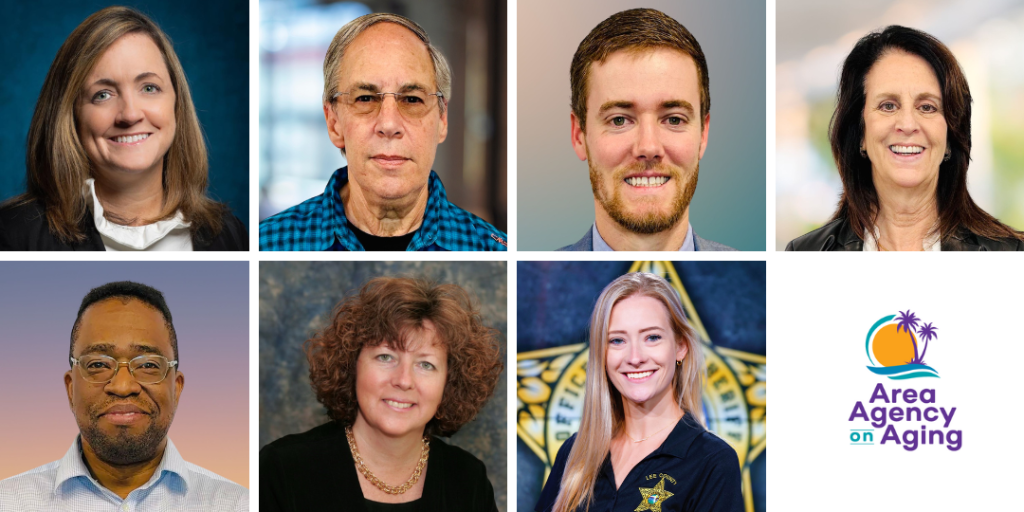
The board of directors of the Area Agency on Aging for Southwest Florida (AAASWFL), a nonprofit serving older adults and adults with disabilities, announced four appointments and welcomed three new board members. Dr. Lesley Clack will serve as chair, Daniel I. Katz as vice chair, Garrett Anderson as treasurer and Pamela D. Keller as secretary. The new board members are Jaha Cummings, Dr. Denise McNulty, and Victoria Staryk.
“We are pleased to welcome our three new board members,” said Maricela Morado. “They will bring valuable insights and will add to the strategic direction our new board leadership are following.”
Dr. Clack has served as a board member since October 2022 and has extensive experience and expertise with the aging population. She is currently an associate professor and chair of the Department of Health Sciences at Florida Gulf Coast University. She also serves as program director for the Bachelor of Science in health administration and Master of Science in health sciences programs. Dr. Clack has been funded by the Department of Health and Human Services to provide evidence-based wellness services to senior adults for the past five years. She regularly presents her work at regional and national conferences on aging.
Dr. Clack holds a Doctor of Science degree in health systems management from Tulane University School of Public Health and Tropical Medicine, a Master of Science degree in counseling psychology from the University of West Alabama, and a Bachelor of Science degree in biological science from the University of Georgia. She is also Certified in Public Health (CPH) by the National Board of Public Health Examiners.
Katz has served as a board member since February 2021. Most recently he was CEO of Jewish Senior Life (JSL) in Rochester, New York, which provides a continuum of health care and senior living from independent and assisted-living apartments to transitional and long-term care. Prior to JSL, he served as vice president of post-acute services at Stamford Health System (SHS) in Stamford, Connecticut serving in various executive positions in long-term care and senior services.
He has served on numerous boards and as chair in both New York and Connecticut related to senior health, Alzheimer’s, aging and long-term care. He earned a bachelor’s in Geography from Syracuse University, and a bachelor’s degree in health services administration from Quinnipiac University in Hamden, Connecticut.
Anderson has served as a board member since October 2021. Currently, he is practice director at NCH Healthcare System, a not-for-profit health care system located in Naples, Florida. Before joining NCH, Anderson had a career as a professional baseball player with the Tampa Bay Rays.
He earned a bachelor’s and a master’s degree in health care administration management from Florida Gulf Coast University.
Keller has served as a board member since August 2016.She is president of Keller Law Office, P.A. in Punta Gorda, Florida and has more than 30 years of experience focusing on elderly law and civil litigation in both Florida and New York. As former chair of the Florida Council for Public Policy representing Florida’s chapters of the Alzheimer’s Association, and as chair of the Legislative Committee for Florida State Guardianship Association, she has lobbied on the state and federal levels on behalf of those affected by Alzheimer’s disease and other cognitive impairments.
As a member of the Board of the Arts & Humanities Council of Charlotte County, she chaired the Council’s Advocacy Committee and founded the Art Therapy Training Program, Expressions from Beautiful Minds. She was also named OCEAN’s 2013, Sunflower Award Recipient which recognizes people who have made a significant contribution as an advocate for the elderly in Charlotte County.
She obtained her JD from St. John’s University School of Law and a Bachelor of Arts from the University of Wisconsin.
New Members
Cummings is the founder of Blanchard House Institute, an organization established to operate in conjunction with the Blachard House Museum’s educational, research and outreach. He also founded the Black Wall Street Trail that celebrates the legacy of the golden age of historic African America Business district impacted by urban renewal and the Seminole Maroon Freedom Trail, a national public-private-philanthropic partnership across industries to build an economic and cultural trail honoring Seminole Maroon quest for freedom. He lived in Asia for 20 years and was a consultant to governmental and high-level executives on market analysis for international health care companies.
He served three terms as a Punta Gorda City Councilman and completed all levels of certification from the Florida League of Cities University’s Institute of Elected Municipal Officials. He is a member of Leadership Florida and serves on numerous boards. Cummings has been involved in various committees and councils, including the Florida Freight Advisory Committee and the Governor’s Taskforce on Abandoned African American Cemeteries. He has also served as Treasurer for the Southwest Florida Regional Planning Council and Vice-Chair of the Charlotte County Tourism Development Council. In addition, he is the President of the Cultural Heritage Center of Southwest Florida. He is a commercial real estate practitioner and investment banker.
Cummings earned his degree in Asian studies from Dartmouth College.
McNulty has 30 years of experience in health care, serving in various administrative, clinical, and teaching roles. Originally from Philadelphia, she relocated to Southwest Florida in 2000.
Currently she is the administrator/CEO of Willough at Naples, a behavioral health hospital specializing in the treatment of dual diagnosis disorders and mental health illnesses in Lely, Florida. She also maintains a private practice in Naples, where she provides therapy for individuals, couples, and families as an advanced practice registered nurse. She is board certified by the American Nurses Credentialing Center as a psychiatric and mental health nurse.
She most recently served as the Director of Behavioral Health for the NCH Healthcare System, Clinical Education Specialist and Mental Health/Addictions Subject Matter Expert for Lee Health, and Chief Clinical Officer for the Baker Senior Center Naples.
She earned a Doctor of Nursing Practice degree from Duquesne University and a Master of Science in Nursing Degree from the University of Pennsylvania. She has a Bachelor of Science degree in nursing from Holy Family University in Philadelphia. In December 2016 she graduated from The Wharton School, University of Pennsylvania Nursing Leaders Program.
Staryk is currently the Central District’s Crime Prevention Practitioner in the Community Response Unit at the Lee County Sheriff’s Office. In her role, she keeps Lee County residents informed of important community news.
She is currently pursuing a degree in business management from Florida SouthWestern State College.


Last Updated: August 13, 2025 by Leave a Comment
Medicare Minute: Medicare for Federal Employees and Retirees
Whether to enroll in Part B or use FEHB as primary coverage is a personal decision, based on your individual circumstances. You should look at the costs and benefits of each insurance plan and make the choice that’s best for you.
Federal Employee Health Benefits (FEHB)
When you become Medicare-eligible, you have a few options:
Keep FEHB and turn down Medicare.
Keep FEHB and enroll in Medicare.
The two will work together to cover your health care costs, but you will owe premiums for both.
Disenroll from FEHB and enroll in Medicare.
You might not be able to enroll in FEHB again in the future if you change your mind.
For a full list of questions to ask yourself when choosing the option that is best for you and more on identifying billing errors download this helpful handout by the Medicare Rights Center.
Who to contact for more information:
• Contact your State Health Insurance Assistance Program (SHIP) if you want to discuss your Medicare enrollment options with a Medicare counselor.
• Contact your Senior Medicare Patrol (SMP) if you may have experienced Medicare fraud, errors, or abuse. In Southwest Florida it is 866-413-5337 or email shineinfo@aaaswfl.org.
• Contact the U.S. Office of Personnel Management (OPM) if you’re a federal employee or retiree and want to learn more about FEHB. You can call 317-212-0454 or visit www.opm.gov/healthcare-insurance.
• Contact United States Postal Service (USPS) if you are a USPS employee, retiree, or eligible family member and need more information on PSHB. Current employees can visit www.liteblue.usps.gov and retirees can visit www.keepingposted.org.
The Medicare Rights Center is the author of portions of the content in these materials but is not responsible for any content not authored by the Medicare Rights Center. This document was supported, in part, by grant numbers 90SATC0002 and 90MPRC0002 from the Administration for Community Living (ACL), Department of Health and Human Services, Washington, D.C. 20201. Grantees undertaking projects under government sponsorship are encouraged to express freely their findings and conclusions. Points of view or opinions do not, therefore, necessarily represent official Administration for Community Living policy. [April 2024]
Last Updated: August 13, 2025 by Leave a Comment
Area Agency on Aging for SWFL Board of Directors Announces Four Appointments and Welcomes Three New Members
The board of directors of the Area Agency on Aging for Southwest Florida (AAASWFL), a nonprofit serving older adults and adults with disabilities, announced four appointments and welcomed three new board members. Dr. Lesley Clack will serve as chair, Daniel I. Katz as vice chair, Garrett Anderson as treasurer and Pamela D. Keller as secretary. The new board members are Jaha Cummings, Dr. Denise McNulty, and Victoria Staryk.
“We are pleased to welcome our three new board members,” said Maricela Morado. “They will bring valuable insights and will add to the strategic direction our new board leadership are following.”
Dr. Clack has served as a board member since October 2022 and has extensive experience and expertise with the aging population. She is currently an associate professor and chair of the Department of Health Sciences at Florida Gulf Coast University. She also serves as program director for the Bachelor of Science in health administration and Master of Science in health sciences programs. Dr. Clack has been funded by the Department of Health and Human Services to provide evidence-based wellness services to senior adults for the past five years. She regularly presents her work at regional and national conferences on aging.
Dr. Clack holds a Doctor of Science degree in health systems management from Tulane University School of Public Health and Tropical Medicine, a Master of Science degree in counseling psychology from the University of West Alabama, and a Bachelor of Science degree in biological science from the University of Georgia. She is also Certified in Public Health (CPH) by the National Board of Public Health Examiners.
Katz has served as a board member since February 2021. Most recently he was CEO of Jewish Senior Life (JSL) in Rochester, New York, which provides a continuum of health care and senior living from independent and assisted-living apartments to transitional and long-term care. Prior to JSL, he served as vice president of post-acute services at Stamford Health System (SHS) in Stamford, Connecticut serving in various executive positions in long-term care and senior services.
He has served on numerous boards and as chair in both New York and Connecticut related to senior health, Alzheimer’s, aging and long-term care. He earned a bachelor’s in Geography from Syracuse University, and a bachelor’s degree in health services administration from Quinnipiac University in Hamden, Connecticut.
Anderson has served as a board member since October 2021. Currently, he is practice director at NCH Healthcare System, a not-for-profit health care system located in Naples, Florida. Before joining NCH, Anderson had a career as a professional baseball player with the Tampa Bay Rays.
He earned a bachelor’s and a master’s degree in health care administration management from Florida Gulf Coast University.
Keller has served as a board member since August 2016.She is president of Keller Law Office, P.A. in Punta Gorda, Florida and has more than 30 years of experience focusing on elderly law and civil litigation in both Florida and New York. As former chair of the Florida Council for Public Policy representing Florida’s chapters of the Alzheimer’s Association, and as chair of the Legislative Committee for Florida State Guardianship Association, she has lobbied on the state and federal levels on behalf of those affected by Alzheimer’s disease and other cognitive impairments.
As a member of the Board of the Arts & Humanities Council of Charlotte County, she chaired the Council’s Advocacy Committee and founded the Art Therapy Training Program, Expressions from Beautiful Minds. She was also named OCEAN’s 2013, Sunflower Award Recipient which recognizes people who have made a significant contribution as an advocate for the elderly in Charlotte County.
She obtained her JD from St. John’s University School of Law and a Bachelor of Arts from the University of Wisconsin.
New Members
Cummings is the founder of Blanchard House Institute, an organization established to operate in conjunction with the Blachard House Museum’s educational, research and outreach. He also founded the Black Wall Street Trail that celebrates the legacy of the golden age of historic African America Business district impacted by urban renewal and the Seminole Maroon Freedom Trail, a national public-private-philanthropic partnership across industries to build an economic and cultural trail honoring Seminole Maroon quest for freedom. He lived in Asia for 20 years and was a consultant to governmental and high-level executives on market analysis for international health care companies.
He served three terms as a Punta Gorda City Councilman and completed all levels of certification from the Florida League of Cities University’s Institute of Elected Municipal Officials. He is a member of Leadership Florida and serves on numerous boards. Cummings has been involved in various committees and councils, including the Florida Freight Advisory Committee and the Governor’s Taskforce on Abandoned African American Cemeteries. He has also served as Treasurer for the Southwest Florida Regional Planning Council and Vice-Chair of the Charlotte County Tourism Development Council. In addition, he is the President of the Cultural Heritage Center of Southwest Florida. He is a commercial real estate practitioner and investment banker.
Cummings earned his degree in Asian studies from Dartmouth College.
McNulty has 30 years of experience in health care, serving in various administrative, clinical, and teaching roles. Originally from Philadelphia, she relocated to Southwest Florida in 2000.
Currently she is the administrator/CEO of Willough at Naples, a behavioral health hospital specializing in the treatment of dual diagnosis disorders and mental health illnesses in Lely, Florida. She also maintains a private practice in Naples, where she provides therapy for individuals, couples, and families as an advanced practice registered nurse. She is board certified by the American Nurses Credentialing Center as a psychiatric and mental health nurse.
She most recently served as the Director of Behavioral Health for the NCH Healthcare System, Clinical Education Specialist and Mental Health/Addictions Subject Matter Expert for Lee Health, and Chief Clinical Officer for the Baker Senior Center Naples.
She earned a Doctor of Nursing Practice degree from Duquesne University and a Master of Science in Nursing Degree from the University of Pennsylvania. She has a Bachelor of Science degree in nursing from Holy Family University in Philadelphia. In December 2016 she graduated from The Wharton School, University of Pennsylvania Nursing Leaders Program.
Staryk is currently the Central District’s Crime Prevention Practitioner in the Community Response Unit at the Lee County Sheriff’s Office. In her role, she keeps Lee County residents informed of important community news.
She is currently pursuing a degree in business management from Florida SouthWestern State College.
Last Updated: August 13, 2025 by Leave a Comment
How to Recognize Scammers and Avoid Scams
The following tips were taken from the Protect Yourself from Government Imposter Scams handout (.pdf) prepared by the Social Security Administration as part of its annual #SlamtheScam campaign.
Recognize Scammers. They may:
How to avoid a scam:
Last Updated: August 13, 2025 by Leave a Comment
Medicare Minute: Part D Coverage Phases
The cost of your Medicare Part D-covered drugs may change throughout the year. If you notice that your drug prices have changed, it may be because you are in a different phase of Part D coverage. There are four different phases—or periods—of Part D coverage.
Deductible Period: Until you meet your Part D deductible, you are in the deductible period. During this time, you will pay the full negotiated price for your covered prescription drugs. While deductibles can vary from plan to plan, no plan’s deductible can be higher than $545 in 2024, and some plans have no deductible. You begin each new calendar year in the deductible.
Initial Coverage Period: After you meet your deductible, your plan will help pay for your covered prescription drugs. This is your initial coverage period. Your plan will pay some of the cost, and you will pay a copayment or coinsurance.
Coverage Gap: You enter the coverage gap when your total drug costs—including what you and your plan have paid for your drugs—reaches a certain limit. In 2024, that limit is $5,030. While in the coverage gap, you are responsible for 25% of the cost of your drugs. The coverage gap is also sometimes called the donut hole.
Catastrophic Coverage: In all Part D plans in 2024, you enter catastrophic coverage after you reach $8,000 in out-of-pocket costs for covered drugs. As of 2024, during this period, you owe no coinsurance or co-payments for the cost of your covered drugs for the remainder of the year. This puts a hard cap on your spending during the catastrophic phase of coverage. Before 2024, you paid 5% of the cost.
But what counts as an out-of-pocket cost? The out-of-pocket costs that help you reach catastrophic coverage include:
Costs that do not help you reach catastrophic coverage include monthly premiums, what your plan pays toward drug costs, the cost of non-covered drugs, the cost of covered drugs from pharmacies outside your plan’s network, and the 75% generic discount.
There are many types of pharmacy and prescription drug schemes. A few examples include:
Read your Medicare statements to check for errors or suspicious charges.
If you have any concerns about your Medicare statements or medications, contact your local Senior Medicare Patrol (SMP). Your SMP can help and report the potential fraud to the correct authorities. Contact information for your local SMP is on the last page of this document.
SHINE is your local SHIP and SMP contact. Call us at 1-866-413-5337 or email us at shineinfo@aaaswfl.org.
All the information in this blog post was taken from the Part D Coverage Phases handout.
The Medicare Rights Center is the author of portions of the content in these materials but is not responsible for any content not authored by the Medicare Rights Center. This document was supported, in part, by grant numbers 90SATC0002 and 90MPRC0002 from the Administration for Community Living (ACL), Department of Health and Human Services, Washington, D.C. 20201. Grantees undertaking projects under government sponsorship are encouraged to express freely their findings and conclusions. Points of view or opinions do not, therefore, necessarily represent official Administration for Community Living policy.
Posted: February 26, 2024 by Leave a Comment
Medicare Advantage Open Enrollment Period Ends March 31!
You can sign up for Medicare Part A and/or Medicare Part B during the General Enrollment Period if both apply:
This opportunity ends March 31, coverage will start the first day of the month after you enroll.
Medicare Advantage Open Enrollment Period (MA-OEP) is a single opportunity for someone currently enrolled in an advantage plan, that is not meeting their needs, to switch back to Original Medicare or another advantage plan. Deadline is March 31.
Call to speak with a SHINE Medicare Counselor at 866-413-5337.
Last Updated: August 13, 2025 by Leave a Comment
Four Signs That It’s a Scam
Protect yourself from fraud by learning how to identify scams. Here are four tactics scammers use:
If you suspect Medicare fraud, contact your local SHIP-SMP program by calling the Elder Helpline at 866-413-5337. Remember, your local SHIP program is known as SHINE (Serving Health Insurance Needs of Elders) in the state of Florida.
For more on the subject, visit How to Avoid a Scam (Federal Trade Commission Consumer Advice).
Posted: February 15, 2024 by Leave a Comment
It’s BINGO Time!
Area Agency on Aging for Southwest Florida (AAASWFL) will be partnering with the Center for Independent Living Gulf Coast and Florida Alliance for Assistive Services & Technology Southwest to host three BINGO events in March. These events are open to older adults (60+) and adults with disabilities (18+). BINGO will be called in both English and Spanish to accommodate all participants. Winners will receive prizes. Seating is limited to the first thirty registered individuals, so secure your spot now by registering at BINGO Registration.
When:
Friday, March 8, 2024
Wednesday, March 27, 2024
Friday, March 29, 2024
1:00 p.m. – 3:00 p.m.
WHERE: 2830 Winkler Avenue, Suite 112, Fort Myers, FL 33916
WHO: Free for older adults (60+) and adults with disabilities
Area Agency on Aging for Southwest Florida is a nonprofit organization serving Charlotte, Collier, DeSoto, Glades, Hendry, Lee and Sarasota counties. AAASWFL is the state’s designated Aging and Disability Resource Center for Southwest Florida. The organization is committed to connecting older adults and adults with disabilities to resources and assistance for living safely with independence and dignity. More information is available at https://www.aaaswfl.org or by calling the toll-free Helpline at 866-41-ELDER.
Posted: January 29, 2024 by Leave a Comment
How to Lower Your Part D Drug Costs
This year, people with Medicare may qualify for even more savings through the Extra Help program. This program helps some people pay their Medicare drug coverage (Part D) costs, like premiums, deductibles, coinsurance, and other costs. The program has expanded in 2024 and you may qualify.
In 2024, everyone who qualifies for Extra Help will pay $0 for their Medicare drug plan premium, $0 for their plan deductible, and a reduced amount for both generic and brand-name drugs! Your local SHINE program can help you see if you’re eligible or how to apply. To request help from SHINE, call the Helpline at 866-413-5337.
Last Updated: January 29, 2024 by Leave a Comment
Medicare Minute: Ending Care Appeals
If you are receiving care in a hospital or non-hospital setting and are told that your Medicare will no longer pay for your care, you have the right to a fast appeal if you feel that continued care is medically necessary. There are separate processes for hospital and non-hospital appeals. Non-hospital care includes care from a skilled nursing facility (SNF), Comprehensive Outpatient Rehabilitation Facility (CORF), hospice, or home health agency. You can appeal by following the instructions on the notices you receive.
Hospital Discharge Appeal
Non-Hospital Discharge
Ending Care Appeals
If the appeal to the BFCC-QIO is successful, your care will continue to be covered, including for the time you were appealing. If the BFCC-QIO decides that your care should end, you can file a second appeal within the timeframe on your BFCC-QIO denial notice.
There are five levels of appeal in total. The timing and agency involved depends on which type of care is ending and whether you have Original Medicare or a Medicare Advantage Plan.
Tips for filing Medicare appeals for care that is ending
• Follow instructions on the notices you receive.
• Stick to important deadlines.
• Keep original copies of information.
• Take thorough notes while appealing.
• Request a letter from your doctor or health care provider in support of your continued care to strengthen your appeal.
• Contact your local State Health Insurance Assistance Program (SHIP) for more guidance on appeals.
SNF Medicare Fraud, Errors, and Abuse
Medicare fraud can occur when a provider or facility bills for services you did not receive or were not medically necessary. Examples of potential skilled nursing facility (SNF) fraud:
SNF services for dates after you were released from the SNF
Contact your local Senior Medicare Patrol (SMP) to report Medicare fraud, errors, or abuse.
Call toll-free: 1-866-413-5337 | Email: shineinfo@aaaswfl.org
Ending Care Appeals available for download.
search this site
popular pages
AAASWFL Programs & Services